A column can appear undersized for several different reasons: inadequate axial or shear capacity, corrosion, poor confinement, buckling risk, excessive slenderness or a foundation that cannot deliver the required load. By separating the structural diagnosis from the strengthening method, you can compare concrete jacketing, steel jacketing, FRP wrapping, section enlargement, grouting and underpinning without treating every defect as a column problem.
Key takeaways
- Confirm the column is the failing link before designing reinforcement.
- Use concrete jackets for capacity gains that require added section and stiffness.
- Choose steel or FRP when access, installation speed or added weight controls.
- Use underpinning when the foundation, not the column, cannot support demand.
When does an existing column need strengthening, and is the column really the problem?
Strengthening is justified when the existing column cannot safely carry current or proposed demand, but the first task is to prove that the column is the failing link.
A column strengthening assessment is triggered by a change of use, added storeys, higher floor loads, fire, vehicle impact, earthquake damage, construction defects, or removal of adjacent beams or columns.
1. Establish the load-path change. Calculate gravity and lateral demands for the existing and proposed building, including transferred reactions after member removal. Check inadequate axial capacity, deficient shear capacity, poor confinement, buckling, excessive slenderness and any lap-splice or transverse-reinforcement weakness.
2. Inspect the column itself. Map cracks, crushing, deformation, exposed bars, delamination and fire damage; measure dimensions; locate reinforcement; and quantify corrosion-related section loss. Strengthening over loose cover or carbonated, corrosion-damaged concrete hides the defect and leaves a weak interface.
3. Test the surrounding system before choosing a jacket. Examine beam-column joints for brittle shear or anchorage failure, slabs for punching, footings for bearing and overturning capacity, soil for differential settlement, and the frame for stiffness imbalance. A stronger column can shift demand into the joint, adjacent beam, splice or foundation.
4. Treat movement or foundation distress at its source. A column repair alone is inadequate when an overstressed footing, punching slab, brittle joint or settlement is driving movement through the frame. Fire-damaged or heavily loaded columns also require temporary propping, partial unloading and a designed load-transfer sequence before drilling, cutting or removing concrete.
How do reinforced-concrete, steel and FRP jackets strengthen a column?
The three jacket systems solve different failures, and the new material carries load only through a designed load-transfer path.
| System | Structural benefit | How load reaches it |
|---|---|---|
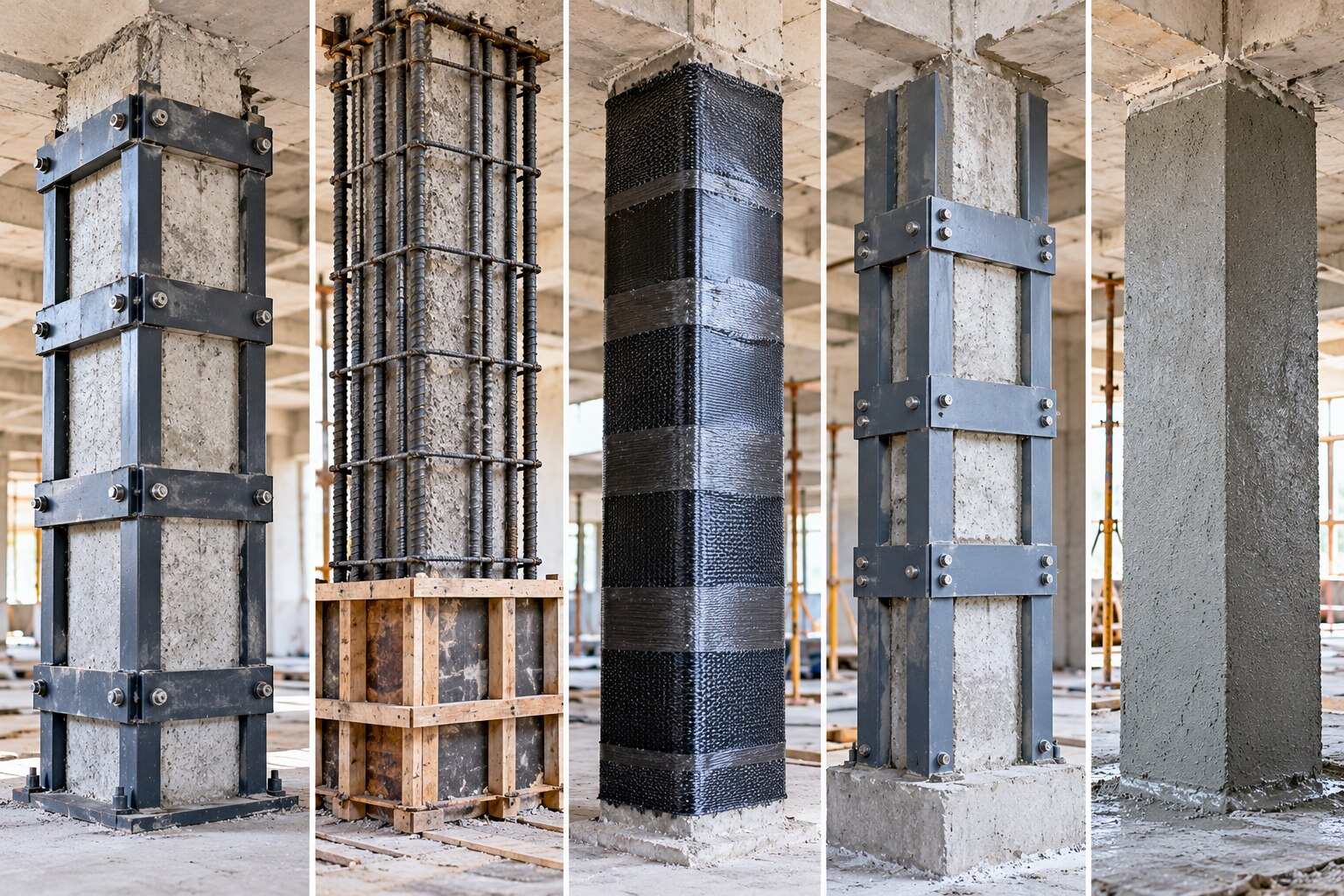
| Reinforced-concrete jacketing | Enlarges the section, increasing axial capacity, stiffness, confinement and fire resistance | Roughen the interface and use dowels, ties, headed connectors or other mechanical details; check reinforcement development and lap lengths |
| Steel jacketing | Adds confinement and shear resistance with less thickness and curing time | Use steel plates and angles with battens, or a fabricated shell; fill gaps with non-shrink grout, provide vents and anchor the jacket at its ends |
| Carbon-fibre-reinforced polymer wrapping | Improves confinement and compression ductility, particularly around circular or rounded-rectangle columns | Bonded fibres act through the prepared substrate and specified overlaps; they do not automatically provide longitudinal reinforcement or a shear mechanism |
A concrete jacket cast around an unloaded column does not instantly carry all existing sustained axial force. It engages as load changes occur unless the design includes unloading, jacking or another active-transfer method.
Steel jacketing suits restricted space, but terminate it through the intended plastic-hinge region and detail continuity at beam-column joints. Provide weld access, end anchorage, grout vents, corrosion protection and fire protection; an unfilled gap can leave the jacket ineffective.
FRP needs rounded corners to prevent stress concentrations, plus a sound, dry, clean substrate. It is the wrong sole remedy for missing longitudinal steel or a deficient shear path.
What roles do micro concrete, pressure grouting and underpinning play?
These methods are not interchangeable repairs; each addresses a different failure in the column or its load path.
- Section enlargement with micro concrete adds a reinforced cage around the existing column. It can restore lost section, add axial and shear capacity, and improve confinement. Resolve bar congestion, dowel spacing, anchorage, interface preparation, development and lap lengths, shrinkage, stiffness, and thermal compatibility before casting.
An unloaded jacket will not immediately carry all existing sustained axial force.
- Pressure grouting fills voids, bonds interfaces, or transfers force through a prepared gap. Specify grout flow, bleed, shrinkage, placement pressure, strength development, venting, and inspection. Long annuli, blocked corners, or inadequate vents can trap air, leaving an apparently solid jacket unsupported; record grout volumes and vent observations, then verify concealed zones where access permits.
- Underpinning transfers load when foundation inadequacy, settlement, added storeys, or a changed load path makes the footing or soil unable to provide the required reaction. Micropiles, jacked piers, helical piers, and jet-grouted soilcrete columns belong to this foundation solution, not to a substitute for checking column capacity.
The choice therefore separates repair material from a designed load-transfer system. Check whether the intervention must engage immediately, transfer future load, improve confinement, or support a new foundation reaction; a stronger column can otherwise shift failure into the joint, adjacent beam, splice, or footing.
How should you choose between a concrete jacket, steel jacket, FRP wrap or underpinning?
Column strengthening method selection starts with the failure you must prevent, the space you can lose and the building’s future use. Compare the options against the same practical criteria:
| Option | Choose it when | Check before approval |
|---|---|---|
| Concrete enlargement | You need higher axial capacity, stiffness, fire resistance or substantial reinforcement, and added column size is acceptable. | Added floor-area loss, clearances, services, finishes, interface preparation, reinforcement congestion and curing time. |
| Steel plates, angles or shell | Floor-area loss and curing time are critical, or seismic confinement and shear improvement are required. | Load introduction, end anchorage, non-shrink grout, vents, fire protection, corrosion, weld access and inspection access. |
| Carbon-FRP wrap | A thin confinement system matches the failure mode, with sound concrete and rounded corners. | Surface flatness, weak cover, contamination, FRP moisture and bond condition, fibre direction, overlap and the specified FRP corner radius. |
| Underpinning | The footing or soil cannot support the required reaction from existing or increased loads. | Micropiles, jacked piers or other foundation works, temporary support, load transfer and settlement compatibility. |
FRP is not a substitute for missing longitudinal steel or every shear mechanism. Remove weak cover, control moisture and protect the resin through FRP fire protection, ultraviolet shielding and impact protection.
Compare the resulting stiffness distribution and seismic force path, not only member capacity. A stronger column can increase beam-column joint, adjacent beam or foundation demand. Include temporary works, access, services, finishes, future inspectability and the building’s intended use before selecting the final system.
What is the safe sequence for designing and installing column strengthening?
A safe sequence begins with evidence and ends only after the strengthened column has been accepted in its final load path.
1. Complete a structural survey and record review. Assess current and proposed loads, then map cracks, deformation and movement. The concrete and reinforcement investigation must cover strength, bar locations, corrosion, carbonation, delamination and fire damage.
2. Diagnose the cause before choosing the treatment. Confirm the column, footing, joint and surrounding frame can support the proposed solution, and document the design loads, connection forces, repair materials and inspection hold points.
3. Design temporary works before removing cover, drilling or cutting. Specify temporary propping, partial unloading and the load transfer sequence. Treat demolition and strengthening as one operation; removing damaged concrete or reinforcement can reduce capacity before the new system engages.
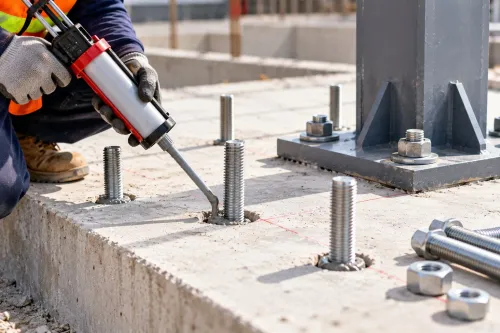
4. Check every anchor and dowel for edge distance, spacing, embedment, cracked concrete, installation direction, hole cleaning, adhesive temperature and curing. Locate existing bars to prevent clashes, and check breakout risk before drilling.
5. After design approval, remove unsound concrete and corrosion products, prepare the interface, and install reinforcement, anchors, steel or FRP. Place grout or micro concrete through planned access points, record grout volumes and vent behaviour, and control curing. For FRP, verify substrate condition, resin saturation and overlaps.
6. Apply specified fire or impact protection, complete load transfer only in the designed sequence, and perform dimensional, visual and as-built inspections. Record anchor installation and proof tests where specified.
Salasar Demolitions Pvt Ltd can be useful where occupied-building work combines controlled removal, anchoring, grouting, repair and strengthening without losing control of the temporary works.
Related products
 | Concrete Jacketing, Carban Wrap, Micro Concrete JACKETING, PRESSURE GROUT & UNDER PINNING OF COLUMNS & BEAMS Underpinning can be achieved with deep foundation elements such as micropiles and MacropilesTM, jacked piers and helical piers, jet grouted soilcrete... View product → |
 | STRUCTURE REPAIRS & REHABILITATIONS The success of a repair or rehabilitation project depends on the specific plans designed for it and guidance is also provided for engineers focused... View product → |
Frequently asked questions
When does an existing column need strengthening?
Strengthening is needed when investigation and structural assessment show that a column cannot safely carry current or proposed loads. Check design demand, concrete condition, reinforcement, cracking, corrosion, damage, load changes and construction deviations first.
How do reinforced-concrete, steel and FRP jackets strengthen a column?
A reinforced-concrete jacket adds concrete and longitudinal bars, increasing axial, bending and shear capacity. A steel jacket adds confinement and load-carrying steel around the column. An FRP wrap provides lightweight confinement and improves axial and lateral performance, but it does not replace missing load paths or repair severe substrate damage.
What roles do micro concrete, pressure grouting and underpinning play?
Micro concrete fills the form around new reinforcement in a concrete jacket. Pressure grouting fills voids, bonds interfaces or repairs inaccessible defects after the cause is identified. Underpinning transfers load to deeper or stronger ground when the foundation or soil, rather than the column alone, is inadequate.
How do you choose between a concrete jacket, steel jacket, FRP wrap or underpinning?
Compare required capacity, fire resistance, available access, added size and weight, installation time, corrosion exposure, substrate condition and foundation capacity. Select underpinning when the support below the column controls the failure.
What is the safe sequence for designing and installing column strengthening?
Survey the structure, establish loads and damage, test materials, verify the load path, design the intervention, temporarily support the column, prepare and repair the substrate, install reinforcement or jackets, grout and cure, then inspect and document the completed work.
Related products
 | Carbonwarpp carbon wrapping for coloum strengthing View product → |
 | Carbon Wrapping MICRO CONCRETING , FIBRE & CARBON WRAPPING With the support of our experienced professionals, we are presenting our clients a qualitative range of Micro Concrete that has tremendous expansion... View product → |