A deep concrete opening is produced by extending a diamond core barrel through the member while controlling alignment, cooling water, slurry and the heavy concrete plug. By the end, you will be able to define the required depth, check whether core drilling is suitable, identify structural and service risks, compare alternative cutting methods and plan removal and reinstatement.
Key takeaways
- Measure coring depth along the drill axis, from entry face to termination or exit face.
- Confirm reinforcement, embedded services and structural loads before drilling.
- Use core drilling for precise circular openings where depth and diameter suit the equipment.
- Control water, slurry, core removal and edge finishing throughout the operation.
How a diamond core barrel creates a deep opening
Long coring is drilling a circular opening farther into concrete than a standard short core. Measure depth along the drilled axis, from the entry face to the hole’s termination or exit face.
Depth is separate from diameter, member thickness and drilling angle. A 100 mm hole drilled 600 mm into a 300 mm wall is a 600 mm-deep blind opening; drilling through a 300 mm wall at an angle creates a longer drilling path than the wall’s nominal thickness.
1. Mark the centre and check the planned axis. Use pilot drilling where needed to establish alignment before fitting the full barrel.
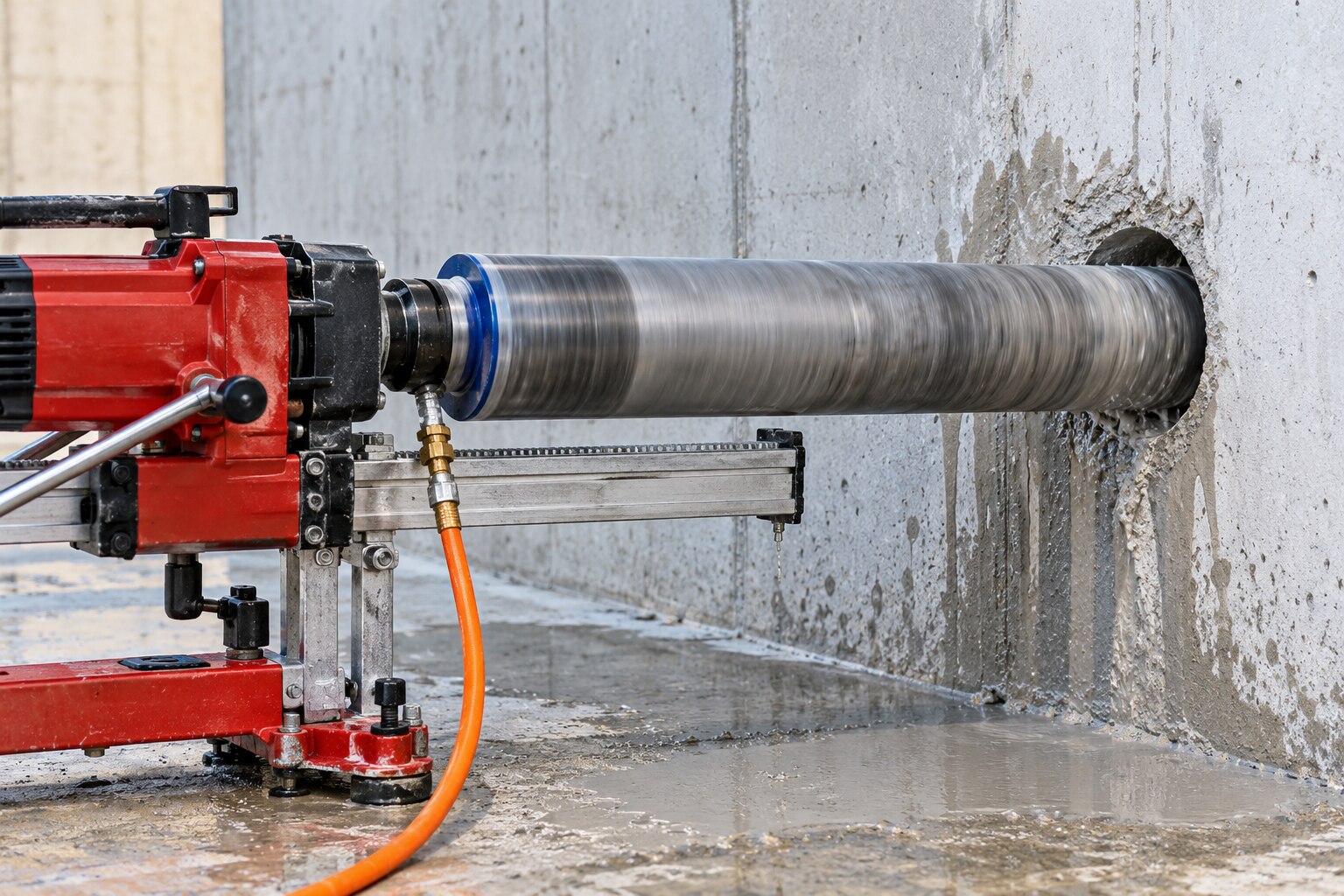
2. Anchor a rigid drill stand and mount the motor with a diamond core barrel. Add barrel extensions as the hole advances; alignment and anchorage must remain stable at every stage.
3. Pump water through the barrel to cool the diamond segments and carry concrete fines out as slurry. Poor flushing packs slurry around the core, increasing friction and reducing cooling.
4. Withdraw the barrel periodically to clear packed spoil, inspect the tool and restore cooling. Do not treat a drilling-rate figure as a completion estimate: surveying, rig setup, reinforcement encounters, core removal, slurry handling and reinstatement also consume time.
5. Break, retrieve or extract the concrete plug in sections rather than lifting a long core as one piece. At 2,400 kg/m³, a solid 100 mm-diameter core weighs about 18.8 kg per metre; a 200 mm core weighs about 75.4 kg per metre.
How to decide whether the opening suits core drilling
Core drilling suits an opening only after you define six constraints: required diameter, required depth, concrete thickness, drilling angle, available access and overhead clearance.
- Diameter controls rig size, slurry volume and core weight.
- Depth determines barrel extensions, withdrawal intervals and extraction method.
- Thickness distinguishes a blind opening from a through-penetration.
- Angle changes the drilling path and the required working space.
- Access determines whether equipment, water lines and slurry collection can reach the location.
- Clearance determines whether the rig, extensions and lifted core can be handled safely.
Map the proposed path before anchoring the rig. Concrete scanning with ground-penetrating radar can show likely reinforcement, conduits, ducts, voids and other anomalies across an area, but it cannot identify every object with equal certainty.
Specify the confidence you need using the quality-level approach in ASCE 38-22. Use direct exposure or radiography when a missed embedded service, tendon or void could cause unacceptable damage.
| Method | Confidence and limitation | Use |
|---|---|---|
| Ground-penetrating radar | Area mapping; object identity remains uncertain | Locate likely reinforcement and embedded services |
| Direct exposure | Physical confirmation at a selected point | Confirm a critical obstruction |
| Radiography | Internal image with controlled access and safety procedures | Confirm objects where exposure is impractical |
Check that the rig can be anchored without striking reinforcement or services. Leave room on the receiving side for breakout protection and core handling.
Dense reinforcement slows penetration, increases tool wear and complicates extraction. Doubling diameter creates about four times the concrete and slurry volume per unit depth.
Core drilling is a poor fit for very large openings, congested reinforcement, unstable access, unsafe contaminated concrete, or unmanageable water and slurry. Compare staged enlargement or smaller penetrations only after checking their combined structural and reinstatement effects.
What structural approval is needed before drilling
A proposed hole in a load-bearing wall, beam, slab, column, retaining wall or foundation requires structural engineer review before drilling. Treat it as a design change, not a routine service penetration.
1. Give the engineer the member’s loads, reinforcement drawings or survey data, proposed opening diameter and location, edge distances, drilling angle and remaining load path. The review can identify reduced shear capacity, lost reinforcement development or anchorage, perimeter cracking, altered stress flow and local strengthening requirements.
2. Apply extra caution to columns and heavily loaded walls. A circular opening can reduce axial, shear or moment resistance even when its edges appear clear.
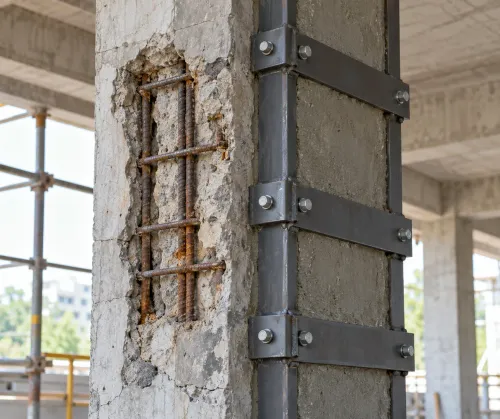
3. Locate reinforcement, embedded conduits, ducts and voids before rig installation. A core barrel does not steer around steel; reinforcement encounters slow penetration and increase vibration, torque and diamond-segment wear. Stop for approval before deliberately severing a bar.
4. Treat post-tensioning tendons differently from ordinary rebar. A tendon strike can cause immediate local damage and loss of prestress, so specialist investigation must confirm tendon location and clearance before an approved drilling plan is issued. Never force the bit through a suspected tendon, duct or unknown obstruction.
5. Install temporary shoring, propping or load transfer when the engineer identifies capacity loss during drilling or while reinforcement is cut. Do not begin until the approved method states how the opening, support condition and any strengthening will be controlled.
How long coring compares with other concrete-cutting methods
Choose long core cutting when you need a round, controlled penetration to a specified depth with less vibration than impact demolition. It still applies torque and thrust through the rig, and a through-hole can break out the far face as the core exits.
| Method | Best suited to | Main limitation |
|---|---|---|
| Long core cutting | Deep, circular holes with controlled diameter and depth | Large diameters increase rig weight, anchorage, water demand and core-handling effort |
| Wall sawing | Straight, relatively shallow cuts and rectangular openings in walls or slabs | Blade diameter and access limit depth |
| Wire sawing | Very thick concrete, large sections and irregular shapes | Requires room to rig and tension the wire, plus a larger exclusion zone |
| Chain sawing | Linear cuts in concrete or masonry where a narrow kerf and hand-held access matter | Does not replace a deep circular hole |
| Rotary percussion drilling | Small holes completed quickly with limited slurry collection | Produces more vibration, dust, breakout and rougher edges |
| Jackhammer | Breaking out large volumes after isolation cuts | Cannot produce a precise deep opening |
Diameter drives removed volume: doubling it creates about four times the concrete volume per unit depth. A large barrel may complete one pass, but pilot drilling, staged enlargement or several smaller holes can reduce rig and anchorage demands while adding layout, noise, breakout and reinstatement work.
Choose among those options after comparing access, core removal, slurry control and the finished repair.
How to control drilling, remove the core and finish the opening
1. Survey the approved opening, scan the drilling path, inspect both faces and establish an exclusion zone. Mark overhead hazards, services, the receiving side and a protected route for core extraction. Include silica exposure controls, electrical protection and a clear emergency stop procedure.
2. Install a rigid rig, align the barrel to the approved angle and verify every anchor or clamp before applying torque and thrust. Connect a controlled water supply, then install bunding, collection trays, sediment separation and temporary drainage before drilling starts.
3. Wet drilling suppresses airborne dust and cools the diamond segments, but alkaline slurry can stain finishes, block drains and create slip and electrical hazards. Capture it continuously, keep it out of occupied areas and arrange lawful disposal; never leave slurry management to the cleanup stage.
4. Drill with planned water flow and periodic withdrawal for flushing, spoil removal and tool inspection. Packed slurry increases friction, reduces cooling and can jam the barrel. Stop if reinforcement, unexpected resistance, vibration or anchor movement appears, and obtain the engineer’s direction before continuing.
5. Inspect and protect the exit face before breakthrough. Use an agreed breakout-control method where concrete cover, waterproofing penetrations or appearance matters; then break, retrieve or extract the core in manageable sections rather than assuming the plug will lift intact.
6. After core extraction, remove slurry, demobilise the rig and reinstate the opening, surrounding concrete and any affected reinforcement.
For a water-retaining or below-grade element, seal the annulus with a flexible seal, hydrophilic product, mechanical compression seal, resin system or cementitious repair selected for movement, moisture, chemicals and surface preparation; generic mortar is not automatically waterproof.
Salasar Demolitions Pvt Ltd can help convert the engineer’s approved opening, scan records and controls into a complete site method statement rather than a drilling-rate quotation.
Related products
 | Core Cutting, Long Coring, Core Prepration For Testing Association of concrete cutting professionals that work together to advance the concrete cutting industry with a strong emphasis on personal safety. View product → |
 | Core Cutting Core Cutting Work View product → |
Frequently asked questions
How does a diamond core barrel create a deep opening?
A rotating diamond-segmented barrel cuts a circular path into concrete. The drilling depth runs along the barrel axis from the entry face to the hole’s termination or exit face.
How do you decide whether an opening suits core drilling?
Check the required diameter and depth, concrete thickness, reinforcement, embedded services, access, water control and whether the opening must pass fully through the member.
What structural approval is needed before drilling concrete?
Obtain approval from the structural engineer responsible for the structure after reviewing drawings, reinforcement scans, embedded services, loads and the proposed opening location and size.
How does long coring compare with other concrete-cutting methods?
Long coring produces a precise circular opening with low vibration. Wall sawing, wire sawing, hand-held cutting and breaking suit different shapes, access conditions, depths and tolerance requirements.