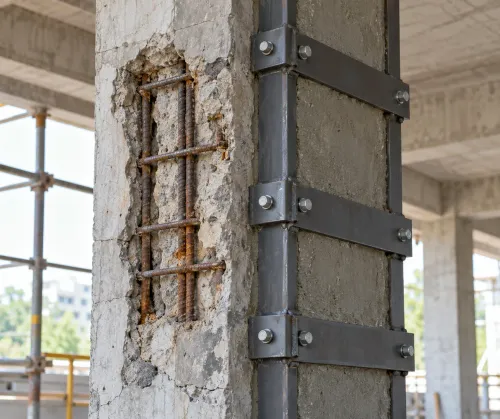

A precise RCC alteration depends on more than choosing a diamond blade: the survey, structural sequence, temporary support and removal plan determine whether the finished opening is safe and usable. By the end, you will know how sawing achieves controlled geometry, which cutting method fits the alteration, and what evidence to require before authorising work.
Key takeaways
- Use track-mounted diamond saws for straight, low-vibration RCC cuts.
- Choose wire sawing, wall sawing or core drilling for the alteration.
- Confirm depth, reinforcement, services and load paths before cutting.
- Inspect dimensions, edges and exposed reinforcement after the cut.
How Diamond Blades Produce a Controlled RCC Cut
Diamond sawing cuts RCC by abrasion: exposed diamond particles grind a narrow kerf instead of striking concrete apart. A track-mounted saw keeps the spindle and blade on a defined path, while matched spindle speed and feed rate limit wandering.
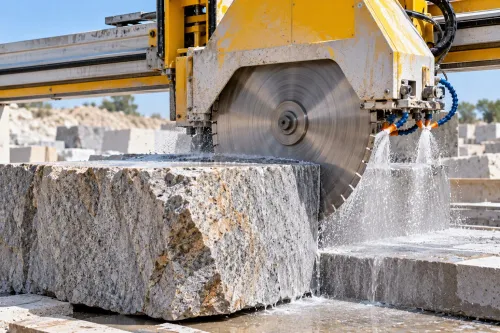
A segmented diamond blade clears slurry and heat through its gaps; a continuous diamond rim gives an uninterrupted edge for cleaner cuts in suitable materials. A continuous diamond rim gasket? That is not a standard cutting component; the correct term is continuous diamond rim.
Impact breakers drive cracks beyond the tool point, so breakout follows aggregate, reinforcement and existing weaknesses. Diamond sawing transmits far less vibration, but low vibration is not zero: blade runout, imbalance, jamming, poor anchorage or reinforcement can create sudden loads.
The cut is only as straight as the survey mark, track alignment, machine mounting and workpiece support.
Precision is limited by:
- Blade bond and diamond concentration: a hard bond can glaze on hard aggregate; a soft bond can wear quickly. Aggregate and reinforcement often control speed more than concrete strength.
- Kerf geometry and depth: a large blade may need multiple passes, and a deflecting blade widens the cut.
- Release and breakout: unsupported panels, thin webs, shallow cover, deteriorated edges or forced wedges can destroy a precise line.
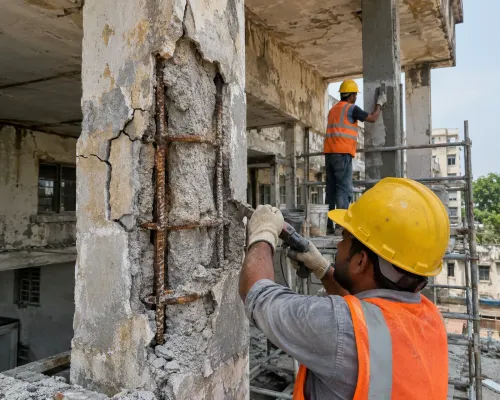
RCC cutting also exposes steel, removes cover and leaves a smooth face that may need roughening and cleaning before bonded repair.
Match the Cutting Method to the Alteration
A standard doorway through a reinforced-concrete wall calls for wall sawing because a track-mounted saw keeps the jambs and head straight. A slab opening calls for floor sawing when the cut is accessible from above; use staged cuts and support the panel before its final separation.
| Method | Best match | Decision point |
|---|---|---|
| Wall sawing | Doorway or wall opening | Use for straight vertical and horizontal cuts on a track; stop short of corners to prevent blade overcut. |
| Floor sawing | Slab opening or road joint | Use for horizontal cuts in slabs and pavement, including contraction joints; confirm the blade depth and joint geometry. |
| Handheld sawing | Short, shallow cuts or restricted access | Use for trimming, small beam-end cuts and locations where a track cannot be anchored; expect less positional control. |
| Wire sawing | Deep beam end, large wall panel or column section | Use when the section exceeds practical blade depth, access is limited, or the shape is irregular. |
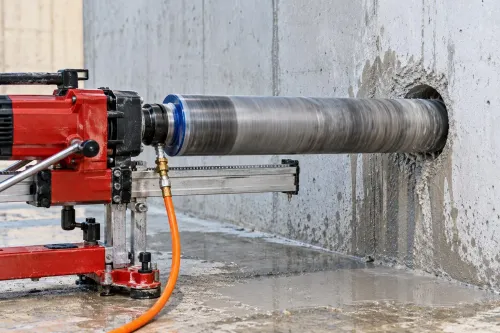
| Core drilling | Circular holes and doorway corner relief | Use for service penetrations or to form clean internal corners, not to remove a complete rectangular opening. |
Wire sawing versus diamond sawing? Wire sawing is a diamond-sawing method, using a diamond-impregnated wire for deep or oversized sections rather than a circular blade. Wall sawing and floor sawing transmit less vibration than impact breaking, but jamming, poor anchorage or reinforcement can still create shock loads.
Specify the finished opening, saw kerf, corner treatment and tolerance separately. A method that fits the equipment but cannot control the final geometry is the wrong choice.
Set the Geometry, Depth and Site Controls Before Cutting
A 300 mm blade does not produce a 300 mm-deep, finished opening. Blade diameter sets the theoretical reach, while flange clearance, spindle arrangement, machine stability and reinforcement reduce the maximum cutting depth. Record the final opening dimensions separately from saw-kerf dimensions and breakout tolerance.
1. Survey the access route and both faces before setting out. Confirm room for a track-mounted saw, blade guard, water supply, slurry collection, electrical power and safe removal of the cut section. Restricted access can force handheld work, smaller blades or extra passes.
2. Align and anchor the track to the marked line, checking level, plumb and stand-off at several points. Track movement, blade run-out, hard aggregate and reinforcement can turn millimetre-scale machine guidance into a visibly misplaced cut.
3. Select the blade bond, segment geometry and diameter for the aggregate, cement matrix, reinforcement density and wet or dry method. A bond that is too hard glazes; one that is too soft wears quickly and increases effort.
4. Make a shallow first pass, then use multiple passes RCC cutting when the required depth exceeds one stable pass. Stage removal into manageable lifts and support the retained concrete before releasing the final connection.
5. Stop the circular blade short of each internal corner. Drill corner relief holes or specify another finishing method; forcing the blade through a corner creates overcuts, weakens the remaining section and can trigger breakout.
6. Control wet slurry, residual dust and unstable offcuts. Use engineered water delivery, no dry sweeping or compressed air, and temporary supports where thin webs, edge cuts or deteriorated concrete could collapse.
Treat Structural Cutting as an Engineered Load-Path Change
Treat any RCC cutting as an engineered load-path change. Before touching a beam, column, slab or wall, an engineer must identify the loads, reinforcement, confinement steel, couplers, embedded services, waterproofing and fire-protection layers that the alteration could interrupt.
1. Review structural drawings, reinforcement details, post-tensioning records, stressing data and service drawings. Define the retained section, temporary supports, lifting method, repair or strengthening detail, and the point at which the load path changes.
2. Complete GPR scanning and electromagnetic locating across the marked area. Use a cover meter for reinforcement depth and direction, but do not treat a clear scan as proof that post-tensioning tendons, ducts, anchorages or grout are absent. Arrange controlled exposure, radiography or trial drilling where congestion or the consequence of a strike warrants it.
3. Mark the cut from fixed reference points, record every detected bar, tendon and service, and obtain engineer approval before rebar locating and RCC cutting begin. Stop if the site condition differs from the survey.
4. Install tracks, restraints and temporary works. A panel weighing several tonnes can release stored load when the final bar is severed, so establish an exclusion zone and support the piece before completing release cuts.
5. Make shallow pilot passes, then deepen the cut in the approved sequence. Never cut a tendon, anchorage or load-bearing reinforcement unless the engineer has approved isolation, de-tensioning or replacement.
6. Remove the supported piece, inspect the remaining concrete and exposed steel, and complete specified corrosion treatment, roughening, cleaning, repair or strengthening. Record photographs, scan data, cut depths and any deviation from the approved method.
Verify the Finished Cut and Compare the Real Job Scope
A finished cut is not verified by its line alone. Inspect the cut faces for the specified depth, straightness, corner breakout, overcutting and damage to retained concrete. Check exposed reinforcement, tendons and services against the approved drawings, and photograph each face, corner and adjoining surface before removal.
Before comparing contractors, require each quotation and close-out file to include:
- Marked-up dimensions, cut depth, tolerances, sequence and number of passes
- Scan records, structural approval, method statement and temporary works plan
- Support, lifting points, exclusion zones and the weight of every removed piece
- Water supply, slurry management, silica control, electrical protection and housekeeping
- Cutting, access, traffic control, lifting, disposal, patching and making-good costs
- Completion photographs, measured results, waste records and any deviation report
Ask Salasar Demolitions Pvt Ltd to separate these items in its price rather than hiding them under “cutting”; that exposes whether a low rate excludes lifting, cleanup or protection. Also ask how the method achieves low vibration versus zero risk: low transmitted vibration does not prevent breakout, blade jamming or a load-path failure.
| Proposed alteration | Diamond sawing is the wrong choice when | Consider instead |
|---|---|---|
| Fragile edge or thin web | The offcut cannot be supported before final cuts | Smaller sections, relief cuts or controlled breaking |
| Irregular demolition | The work requires uncontrolled removal rather than a clean boundary | Selective demolition with engineer-approved sequencing |
| Dust- or water-sensitive area | Wet slurry cannot be captured and dry silica control is inadequate | Enclosure, vacuum-assisted cutting or another approved method |
Frequently asked questions
How does diamond sawing produce a controlled RCC cut?
Diamond particles abrade concrete inside a narrow kerf. A track-mounted saw controls the blade path, while spindle speed and feed rate limit wandering.
How do you choose the right RCC cutting method?
Match the method to the alteration: use wall sawing for straight openings, core drilling for circular penetrations, and wire sawing for large or irregular sections.
What must you confirm before structural cutting?
Set the cut geometry and maximum depth, locate reinforcement and embedded services, plan slurry and debris control, and obtain an engineered load-path assessment.
How should you verify a finished diamond-sawn cut?
Check the opening against its drawings, inspect edge damage and exposed reinforcement, remove loose concrete, and record dimensions and any deviations.