Creating a deep opening through reinforced concrete is rarely as simple as drilling a conventional hole. Thick slabs, beams, foundations and concrete walls often contain dense reinforcement and require highly controlled cutting. Long core cutting is designed for these demanding applications, allowing circular openings to be formed through substantial RCC depths with accuracy.
The technique is commonly used during construction modifications, industrial installation work and building rehabilitation. It is particularly valuable when the surrounding concrete must remain intact.
How Long Core Cutting Works
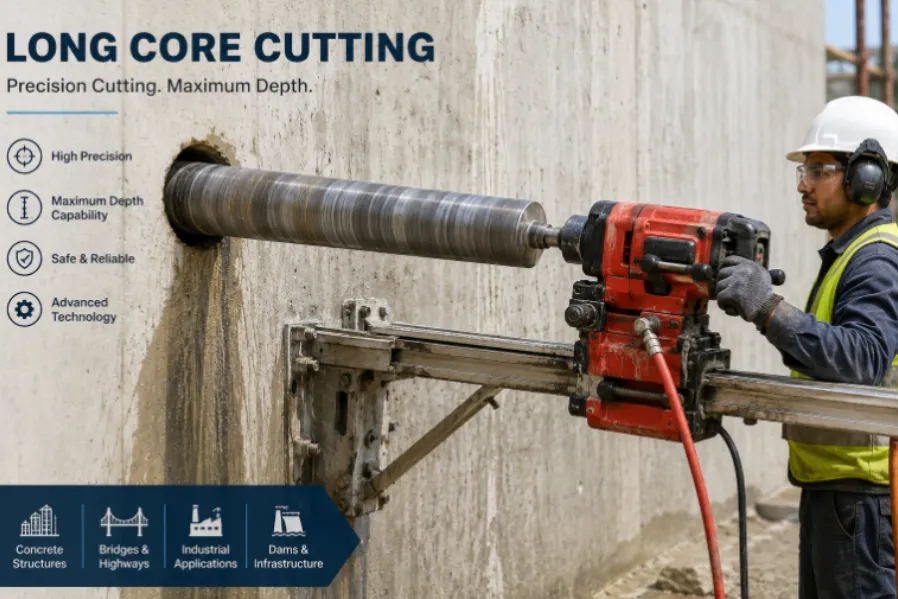
Long core cutting uses a diamond-tipped core barrel mounted on a stable drilling system. As the barrel rotates, its diamond segments gradually cut through concrete and reinforcement. Instead of breaking the material into fragments, the process removes a cylindrical concrete core.
The equipment is securely anchored to maintain alignment throughout the drilling depth. Water is normally supplied to the cutting area to cool the diamond segments, reduce airborne dust and carry away slurry.
Depending on the project, drilling may be performed vertically, horizontally or at a specified angle. The diameter and depth of the opening are selected according to the intended installation.
Where Is Long Core Cutting Used?
This specialised method supports a wide range of structural and utility requirements, including:
- Openings for large plumbing lines
- HVAC duct and service passages
- Electrical cable routes
- Firefighting and sprinkler pipelines
- Industrial process piping
- Foundation testing and sampling
- Anchor and dowel installations
- Drainage outlets through thick slabs
- Openings for mechanical equipment
- Retrofitting work in existing buildings
It is also used where a standard core drill cannot achieve the required depth in a single controlled operation.
Why Conventional Breaking May Not Be Suitable
Using breakers or impact tools to create a deep RCC opening can produce irregular edges and unnecessary cracking. The repeated impact may also transmit vibration into nearby structural elements, finishes or operating machinery.
Long core cutting provides several practical advantages:
- A smooth, circular opening
- Better dimensional accuracy
- Lower vibration than impact breaking
- Controlled cutting through steel reinforcement
- Reduced damage around the opening
- Easier installation of pipes and sleeves
- Less corrective finishing after cutting
Because the process is controlled, it is well suited to occupied buildings, laboratories, hospitals, factories and commercial premises where disturbance must be managed carefully.
Long Core Cutting Requirements in Nagpur Projects
Construction and renovation projects in Nagpur frequently involve RCC buildings with changing service requirements. Commercial properties may need new air-conditioning lines, factories may require process-pipe modifications, and older buildings may need upgraded plumbing or electrical routes.
Before cutting begins, the work area should be checked for reinforcement, concealed cables and embedded pipelines. The drilling position must also be assessed from both sides wherever possible. When cutting through a ceiling or elevated slab, arrangements are needed to support and remove the heavy concrete core safely.
Salasar Demolitions Pvt Ltd evaluates the concrete depth, reinforcement pattern, access conditions and required opening size before selecting the equipment. This preparation is important because longer cores create additional challenges related to alignment, barrel movement and core retrieval.
Key Factors That Affect the Result
Accurate marking is essential. Even a minor deviation at the surface can become significant over a long drilling depth. A rigid equipment setup helps keep the opening aligned, while suitable diamond segments improve cutting through hard aggregates and reinforcement.
Water and slurry must also be managed properly. In finished interiors or active facilities, collection systems can help prevent slurry from spreading to adjacent areas. Where water use is restricted, the contractor must assess an appropriate alternative cutting arrangement.
Long core cutting offers a practical way to modify thick RCC elements without widespread demolition. When supported by structural checks, accurate positioning and suitable equipment, it creates service openings that are cleaner, safer and easier to integrate into the next stage of construction.
Keywords